Research
Genes do not tell the full story of evolution. Cultural traits—behaviors that are learned from others—can change more rapidly than genes and can be inherited not only from parents, but also from others in the population, leading to complex evolutionary dynamics. Often, behaviors are crucial to the survival and reproduction of individuals in a population. When these evolutionarily relevant behaviors are learned instead of genetically encoded, how does the trajectory of evolution change?
We investigate this question in multiple contexts: the evolution of learned song in oscine songbirds, cultural and genetic evolution in humans, and theoretical models of cultural evolutionary dynamics.
The evolution of learned song in oscine songbirds
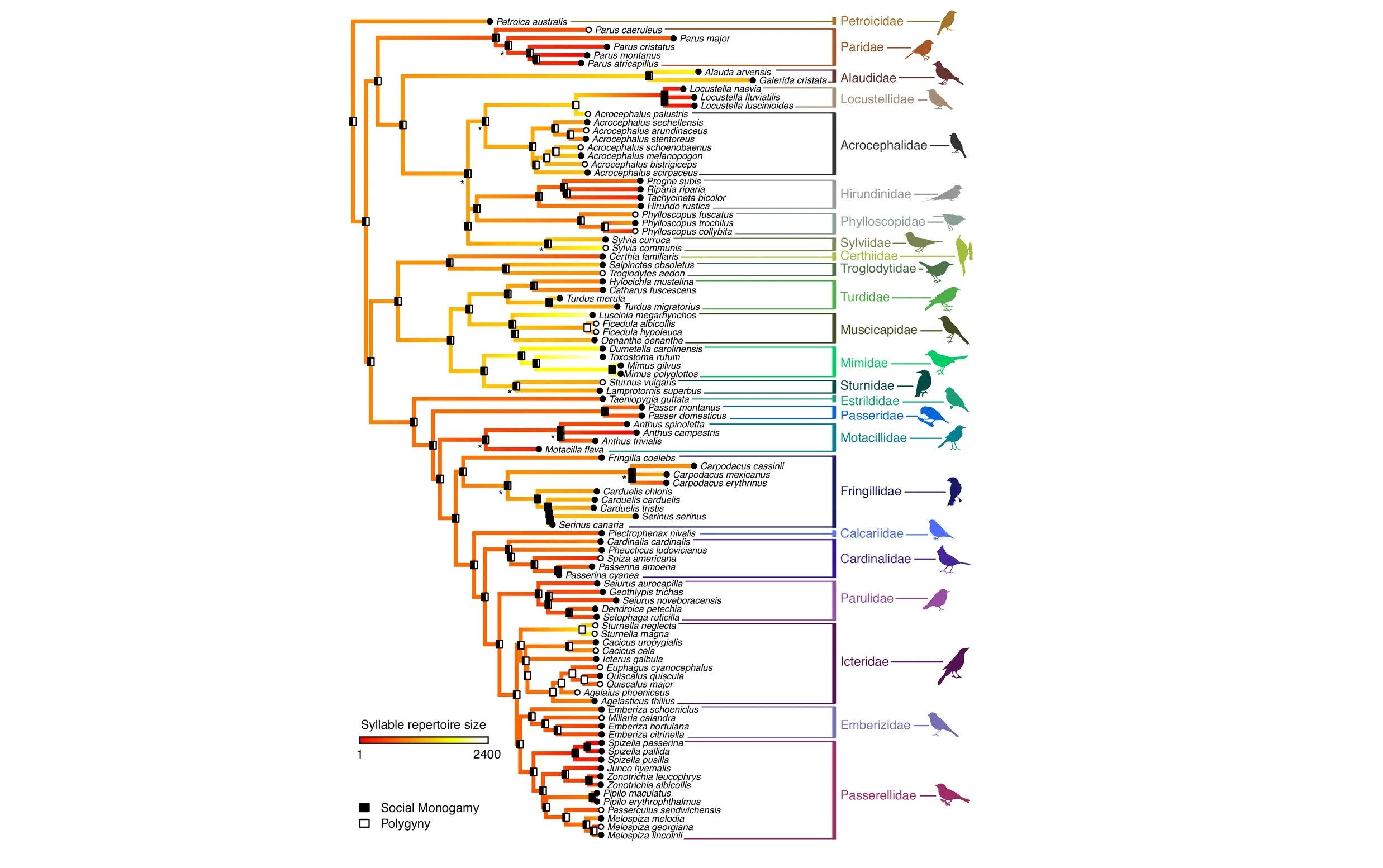
Correlated evolution of mating systems and birdsong elaboration (Snyder & Creanza, Nature Communications 2019).
Key Publications
- KT Snyder†, A Loughran-Pierce#, N Creanza* (2026). Territoriality modulates the coevolution of cooperative breeding and female song in songbirds. Nature Ecology and Evolution. DOI →
- León Du’Mottuchi X★, Creanza N* (2025). The role of learned song in the evolution and speciation of Eastern and Spotted towhees. PLOS Computational Biology 21(6): e1013135. DOI →
- Snyder KT†, Sellers ML#, Creanza N* (2024). Cultural signatures of punctuated environmental change: measuring the effects of population-wide stress on song distribution in dark-eyed juncos and song sparrows. Journal of Field Ornithology 95(2). DOI →
- Hudson EJ†, Creanza N* (2022). Modeling how population size drives the evolution of birdsong, a functional cultural trait. Evolution 76(6): 1139-1152. DOI →
- Searfoss AM★, Pino JC, Creanza N* (2020). Chipper: Open-source software for semi-automated segmentation and analysis of birdsong and other natural sounds. Methods in Ecology and Evolution 11(4): 524-531. DOI →
- Robinson CM★=, Snyder KT★=, Creanza N* (2019). Correlated evolution of repertoire size and song plasticity predicts that sexual selection promotes open-ended learning. eLife 8: e44454. DOI →
- Snyder KT★, Creanza N* (2019). Polygyny is linked to accelerated birdsong evolution but not to larger song repertoires. Nature Communications 10: 884. DOI →
- Creanza N, Fogarty L, Feldman MW (2016). Cultural niche construction of repertoire size and learning strategies in songbirds. Evolutionary Ecology 30: 285–305. DOI →
Cultural and genetic evolution in humans
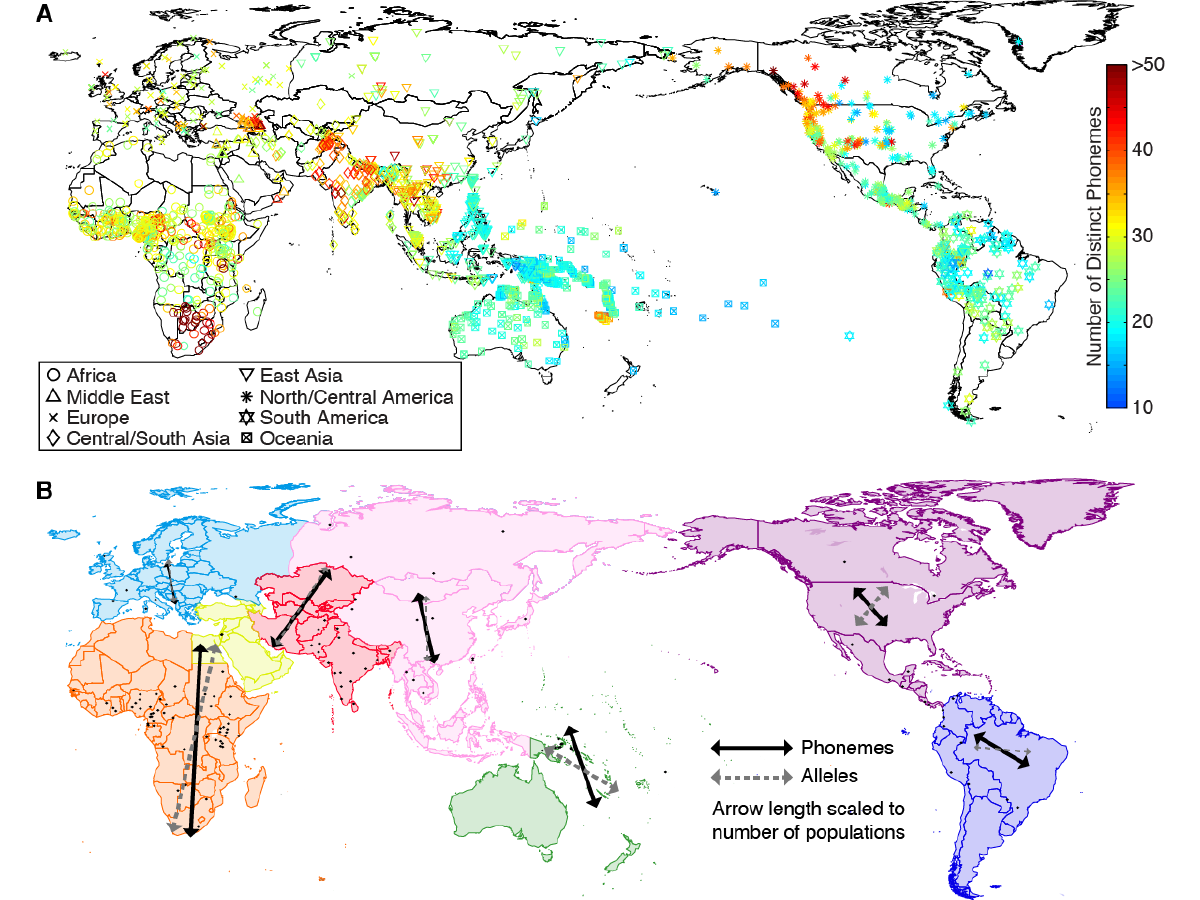
Worldwide comparison of phonemic and genetic variation in human populations (Creanza et al., PNAS 2015).
Key Publications
- Pichkar Y★, Surowiec A#, Creanza N* (2024). Genetic and linguistic comparisons reveal complex sex-biased transmission of language features. Proceedings of the National Academy of Sciences 121 (48): e2322881121. DOI →
- Pichkar Y★, Creanza N* (2024). Joint analysis of human linguistic and genomic variation. Chapter in the Oxford Handbook of Empirical Approaches to Language Evolution.
- Pichkar Y★, Creanza N* (2023). Fine-scale cultural variation reinforces genetic structure in England. American Journal of Biological Anthropology 181(4): 636-636. DOI →
- Atkinson EG, Dalvie S=, Pichkar Y★=, ... Creanza N, ... Martin AR (2022). Genetic structure correlates with ethnolinguistic diversity in eastern and southern Africa. American Journal of Human Genetics 109(9): 1667-1679. DOI →
- Surowiec A#, Snyder KT★, Creanza N* (2019). A worldwide view of matriliny: Using genetic data to shed light on the evolution of human kinship systems. Philosophical Transactions of the Royal Society B 374(1780): 20180077. DOI →
- Sherriah AC, Thomas EAC, Devonish H, Creanza N* (2018). Using features of a Creole language to reconstruct population history: tracing the English origins of Sranan in Suriname. Philosophical Transactions of the Royal Society of London B 373: 20170055. DOI →
- Rathmann H, Reyes-Centeno H, Ghirotto S, Creanza N, Hanihara T, Harvati K (2017). Reconstructing human population history from dental phenotypes. Scientific Reports 7(1): 12495. DOI →
- Creanza N, Ruhlen M, Pemberton TJ, Rosenberg NA, Feldman MW, Ramachandran S (2015). A comparison of worldwide phonemic and genetic variation in human populations. Proceedings of the National Academy of Sciences 112: 1265–1272. DOI →
Theoretical models of cultural evolutionary dynamics
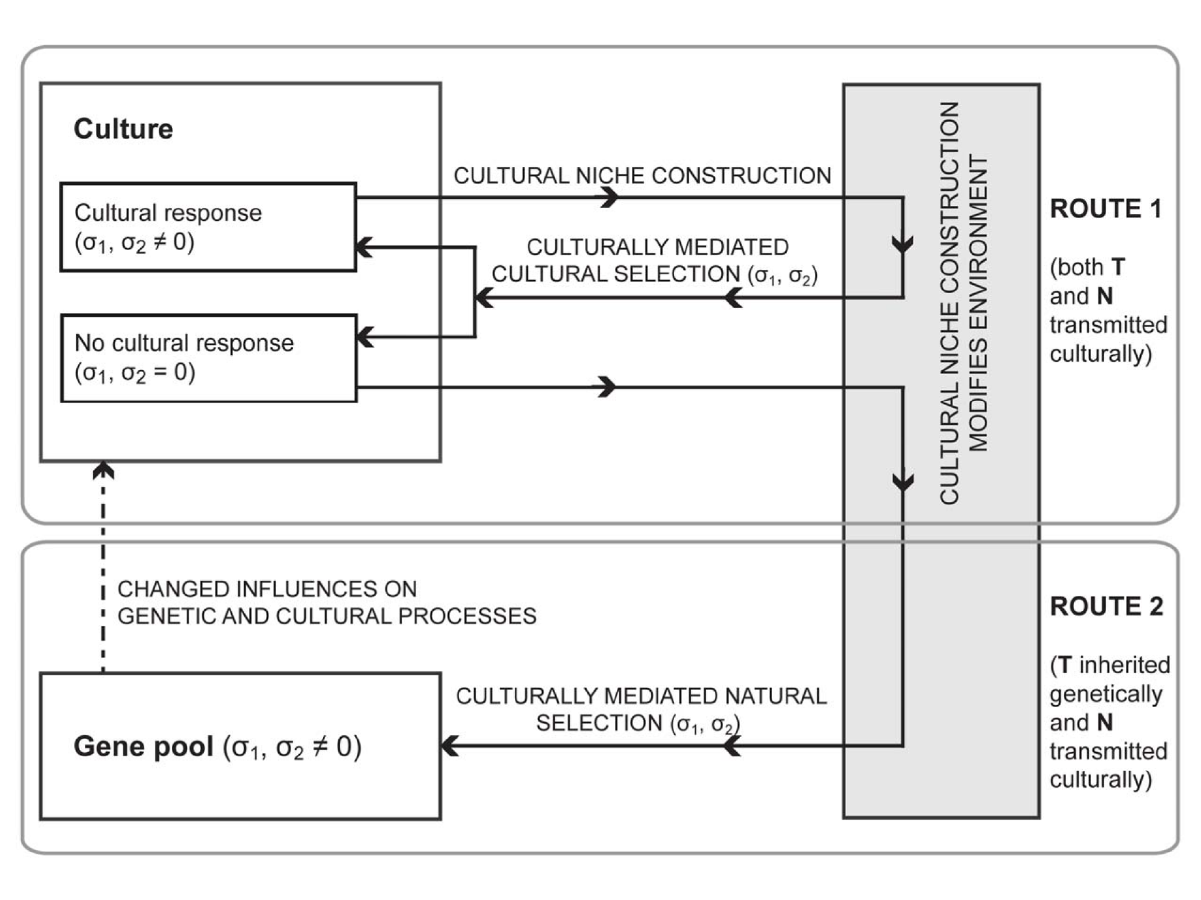
Theoretical dynamics of cultural niche construction and evolutionary interactions (Creanza, Fogarty, & Feldman, PLoS ONE 2012).
Key Publications
- Fogarty L, Kandler A, Creanza N, Feldman MW (2024). Half a century of quantitative cultural evolution. Proceedings of the National Academy of Sciences 121 (48): e2418106121. DOI →
- Anderson K-AM★, Creanza N* (2023). Internal and external forces affecting vaccination coverage: modeling the interactions between vaccine hesitancy, accessibility, and mandates. PLOS Global Public Health 3(6): e0001712. DOI →
- Anderson K-AM★, Creanza N* (2023). The Cultural Evolution of Vaccine Hesitancy: Modeling the Interaction between Beliefs and Behaviors. Theoretical Population Biology 152: 23-38. DOI →
- Ben-Oren Y, Kolodny O*, Creanza N* (2023). Cultural specialization as a double-edged sword: division into specialized guilds might promote cultural complexity at the cost of higher susceptibility to cultural loss. Philosophical Transactions of the Royal Society B 378: 20210418. DOI →
- Fogarty L*, Creanza N, Feldman MW (2019). The life history of learning predicts population-level effects of cultural transmission. PLOS Computational Biology 15(4): e1006821. DOI →
- Creanza N=*, Kolodny O=*, Feldman MW (2017). Cultural evolutionary theory: how culture evolves and why it matters. Proceedings of the National Academy of Sciences 114(30): 7782-7789. DOI →
- Kolodny O=*, Creanza N=*, Feldman MW (2016). Game-changing innovations: how culture can change the parameters of its own evolution, inducing abrupt cultural shifts. PLOS Computational Biology 12(12): e1005302. DOI →
- Kolodny O=, Creanza N=, Feldman MW (2015). Evolution in leaps: the punctuated accumulation and loss of cultural innovations. Proceedings of the National Academy of Sciences 112(49): E6762-E6769. DOI →
- Creanza N, Feldman MW (2014). Complexity in models of cultural niche construction with selection and homophily. Proceedings of the National Academy of Sciences 111: 10830–10837. DOI →
- Creanza N=, Fogarty L=, Feldman MW (2012). Models of niche construction with selection and assortative mating. PLoS ONE 7: e42722. DOI →